 Google
 Doctify


Acne scars
For selected depressed scars, gradual dermal support can complement a plan addressing scar shape and tethering. Cannula subcision has a separate mechanical role where appropriate.

Certified Juvelook clinic · International Juvelook trainer
Understand Juvelook’s PDLLA and hyaluronic acid formulation, porous particle design and gradual collagen-related response. Our certified Juvelook clinic brings international-trainer experience to a clear, doctor-led explanation.
Explore the manufacturer’s mechanism diagram, hydration and temperature data, treatment benefits and the difference between emerging research and a personal clinical result.
Certified clinic · View trainer documentation →Free doctor-led consultation · clear treatment prices

Your skin. Your priorities. A thoughtful plan.
Good treatment information connects the formulation to the tissue and concern. This guide explains product science without assuming that every laboratory pathway produces the same outcome in people.
Our clinic experience informs preparation and technique. Manufacturer material data and published research help explain what is inside the vial and the questions still being studied.
Our certified clinic combines international Juvelook trainer experience, repeated visits to South Korea and careful doctor-led assessment. We explain the product, amount and technique selected for you, with time to ask questions.
Suitable preparation, numbing, attentive treatment, aftercare and skincare advice are included. Your doctor reviews the response before recommending more.
Clinic review totals checked 3 November 2026. Explore our patient reviews · Read our selected Trustpilot reviews
Choose the concern · compare the complete plan
Consultation is free and doctor-led. Treatment options begin at £499 for under-eye Juvelook; each area and combination has its own published price.
Inside your treatment

A Korean injectable combining biodegradable PDLLA particles with non-crosslinked hyaluronic acid, selected for gradual skin-quality care.
Prepared syringe volume depends on preparation. Your doctor explains the agreed amount and concentration. Lenisna / Juvelook Volume is a separate formulation for a different treatment purpose.
Skin concerns, clearly connected
The manufacturer describes Juvelook for collagen-focused skin rejuvenation, including the concerns below. We match these possibilities to your skin and explain the purpose of each treatment.
For selected depressed scars, gradual dermal support can complement a plan addressing scar shape and tethering. Cannula subcision has a separate mechanical role where appropriate.
Skin-quality care focuses on suitable fine lines around delicate areas, while deeper folds, movement and volume loss need their own assessment.
The aim is a smoother-looking surface and refined-looking pores as the supporting skin responds. Pores are normal structures; treatment does not erase them.
Hydration support and a gradual change in texture can create a fresher, more luminous appearance. Dullness and pigment are assessed separately when choosing a combination.
PDLLA is selected for a gradual response rather than an immediate structural filler effect. Longevity depends on the area, technique, skin and individual response.
The manufacturer describes a porous particle design and a favourable safety profile. Genuine product, appropriate preparation, placement and aftercare remain essential; no injection is risk-free.
Explore how Juvelook works: particles, cell signalling and collagen →
PDLLA + HA · from particles to skin quality
Juvelook is a Korean injectable combining biodegradable poly-D,L-lactic acid (PDLLA) microparticles with non-crosslinked hyaluronic acid (HA). HA provides a hydrating carrier. The PDLLA component is used to encourage a gradual collagen-related tissue response. An early hydrated appearance and later remodelling are different stages.
The original powder is reconstituted for treatment. Liquid volume is different from active product content. Preparation, distribution and the selected tissue layer matter together.
The manufacturer describes interactions between porous PDLLA particles, immune cells and supporting skin cells. This is a proposed biological pathway, rather than an instant filling process.
Fibroblast-related collagen changes develop gradually. We assess skin quality and the features you wanted to improve before recommending additional treatment.
VAIM describes a sequence involving mechanical signalling through Piezo1 channels, calcium entry, a shift towards M2-type macrophage activity and signals to neighbouring cells. Its diagram connects these pathways with fibroblasts, vascular cells, fat-cell precursors and hair-follicle stem cells.
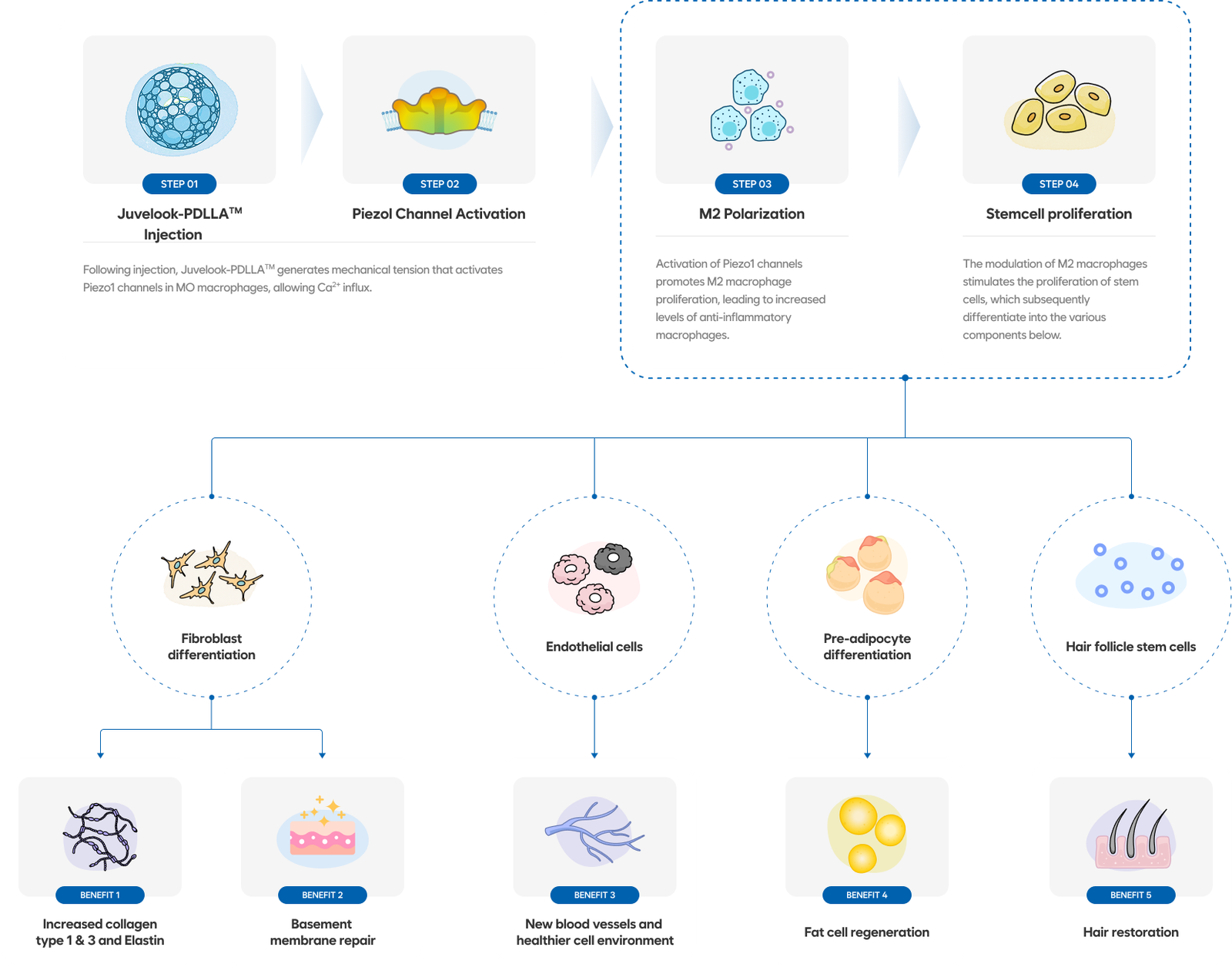
Read the official manufacturer mechanism and benefits explanation ↗
Inside the formulation
The manufacturer describes a porous internal network created through its particle-manufacturing process. It is designed to support cell interaction and degradation through hydrolysis. PDLLA and PLLA share a lactic-acid polymer family but have different material structures and behaviour.
Biodegradable describes the material breaking down over time; it is not a promise that the tissue response disappears on an exact date.
Standard Juvelook contains 42.5mg PDLLA and 7.5mg non-crosslinked HA in an original 50mg vial. Prepared millilitres depend on reconstitution. Your doctor explains the amount and preparation selected for the agreed area.
Lenisna / Juvelook Volume is a separate formulation. Its larger original content and different particle profile are used for a different treatment purpose.
Manufacturer particle technology ↗ · Compare Lenisna / Juvelook Volume →
Material science, explained simply
Glass transition temperature (Tg) describes a polymer changing from a rigid state towards a more flexible state. The manufacturer reports the following material data:
| Condition | Juvelook PDLLA | PLLA comparator |
|---|---|---|
| Dry material | 50–60°C | 60–65°C |
| After hydration | 39°C | 60–65°C |
Hydration changes the material’s flexibility. The manufacturer also discusses clinician-led use of energy-based treatment for softening and dispersing some particle collections. This is a material-management explanation, not a home treatment instruction.
PDLLA is not dissolved by hyaluronidase in the same way as an HA filler. Any lump or unusual change needs clinical assessment; no method is suitable for every situation.
In our clinic’s experience, a coordinated plan can address more than one layer or concern. Juvelook targets skin quality; selected Ultraformer MPT treatment has a separate ultrasound role. A peel may target suitable superficial pigmentation.
The 39°C material data alone does not prove that heating produces greater collagen gains. We choose the device, area, timing and settings for a defined clinical purpose rather than promising universal “activation”.
See our under-eye combination choices → · Explore Ultraformer MPT →
Different questions · different evidence
Human studies explore skin quality, lower-eyelid rejuvenation and selected acne-scar protocols. Product preparation, techniques and schedules vary, so one study cannot predict every clinic combination.
Manufacturer explanations include collagen and elastin pathways, basement-membrane support, blood-vessel formation and adipogenesis. These biological findings do not mean every patient gains every effect.
PDLLA research explores macrophage and follicle signalling, including aged-animal experiments. This is emerging evidence rather than proof of reliable human hair regrowth. A diagnosis remains the first step.
The product page also discusses pigmentation and stretch marks alongside skin rejuvenation, tear-trough care, fine lines and acne scars. These involve different tissue concerns and evidence; they are not automatically covered by one appointment or a promise that every mark will respond. We assess pigment, scar type and the intended treatment area before recommending care.
Read our focused Juvelook hair-loss and scalp assessment guide →
Doctor-led treatment in King’s Cross
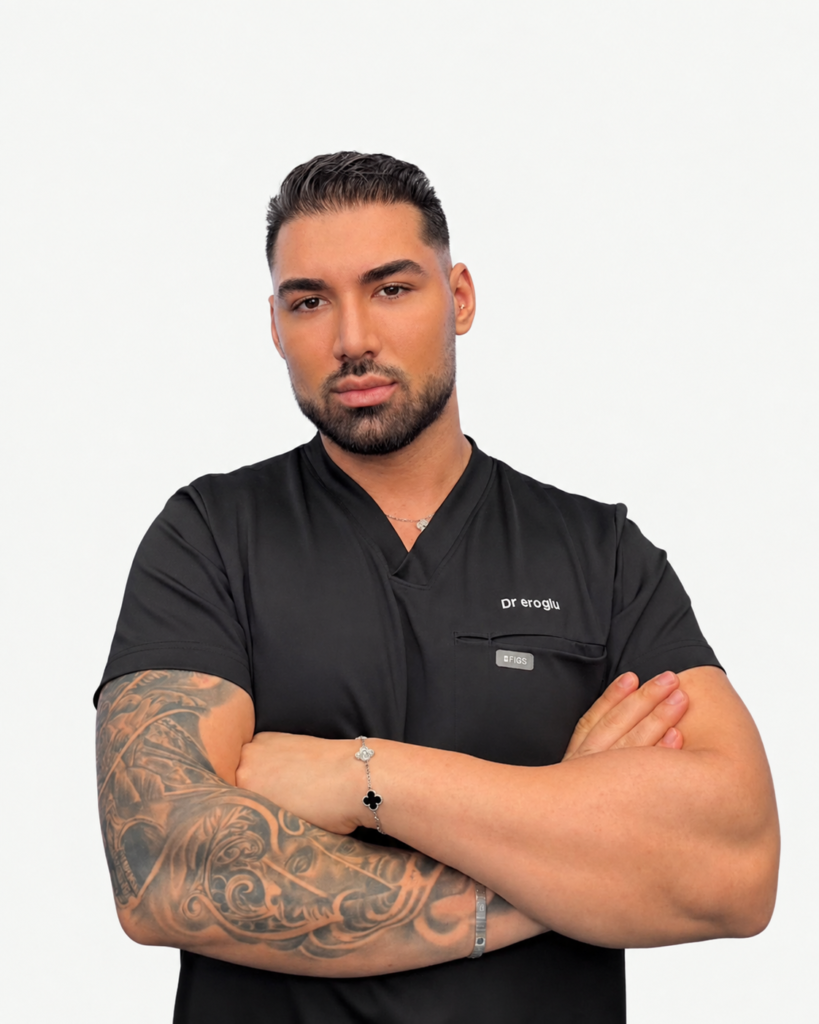
Founder of London Finsbury Clinic and an international Juvelook and Lenisna (Juvelook Volume) trainer, Dr. Eroglu combines Korean collagen-stimulation protocols with a personal, doctor-led approach.
Your consultation starts by listening to what you would like to improve. We assess skin quality, the under-eye area, pigmentation and facial support before recommending a preparation or combination. Dr. Eroglu also has four years of advanced CPD teaching experience, training other practitioners in anatomy, techniques and treatment planning. Your doctor explains the ingredients, amount, suitability and proposed course before you decide.
We welcome local and international patients, with treatment and review planned around your needs. Our aim is a refreshed appearance that respects your natural features.
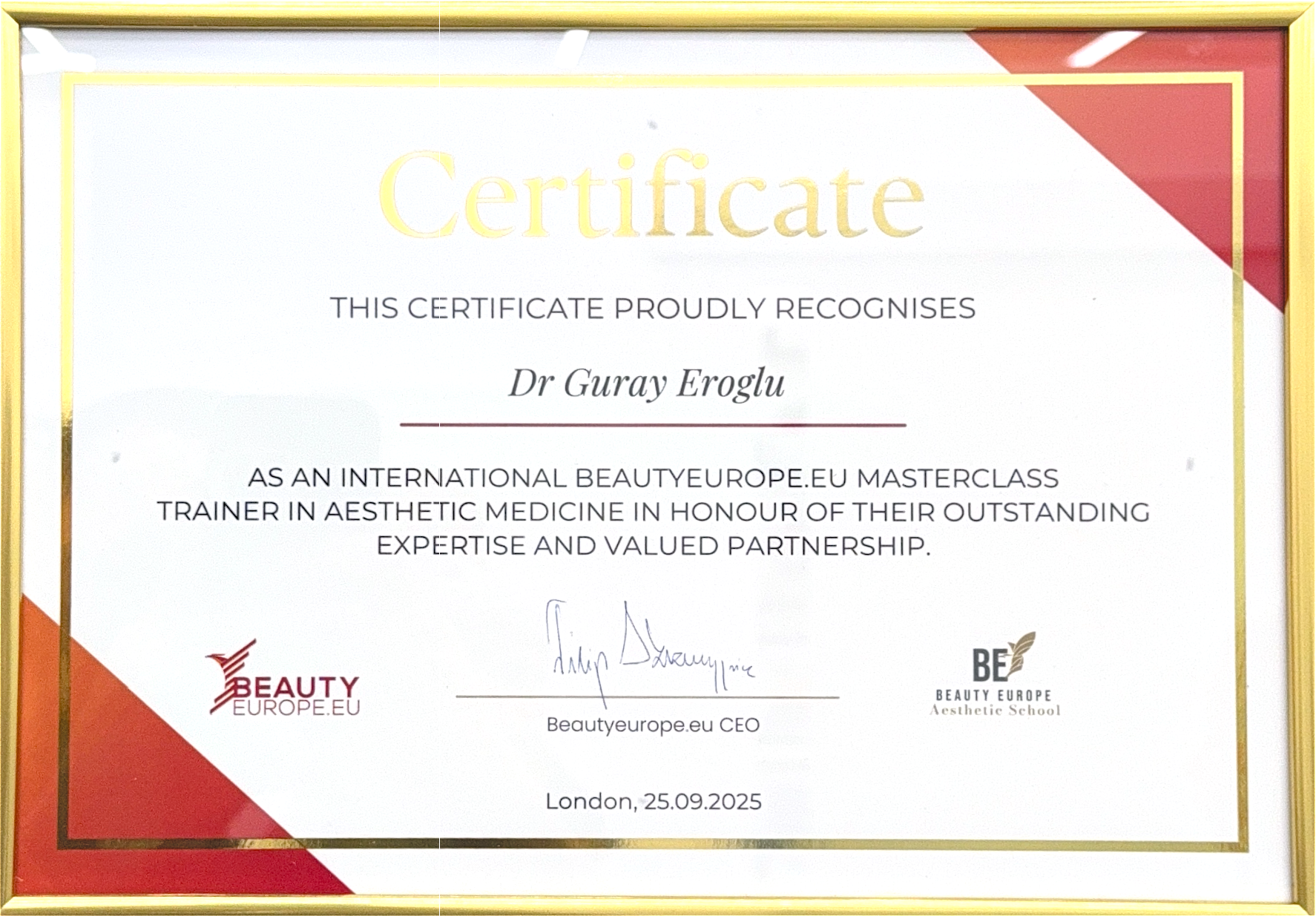
The displayed certificate was issued when Beauty Europe / B2 Europe was the UK distribution and training partner. It documents the training completed during that period; distribution arrangements have since changed.
From explanation to consultation
Our free doctor-led consultation connects the product science with your skin, treatment area and goals. Compare the full treatment menu and included care →
Your questions, clearly answered
Standard Juvelook combines 42.5mg PDLLA with 7.5mg non-crosslinked hyaluronic acid in an original 50mg vial. Prepared syringe volume depends on reconstitution.
No. PDLLA is a biodegradable polymer selected for a gradual tissue response; non-crosslinked HA is the hydrating carrier in Juvelook.
The manufacturer describes particle–cell signalling and supporting-cell activity that can encourage collagen-related remodelling. The response develops gradually and varies between people.
Piezo1 is a mechanically sensitive ion channel. It appears in the manufacturer’s explanation of how particles may influence macrophage signalling. This does not establish every downstream effect in patients.
It is the manufacturer’s reported glass transition temperature for hydrated Juvelook PDLLA. It describes a material becoming more flexible, rather than a guaranteed threshold for better clinical results.
We may combine a device for a separate concern such as suitable laxity. Material softening with heat is not proof that every heated treatment produces greater collagen stimulation.
PDLLA is not reversed by hyaluronidase in the same way as HA filler. The manufacturer describes clinician-led approaches to some particle collections; management depends on assessment.
We assess fine lines, uneven texture, enlarged-looking pores, selected acne scars and suitable delicate under-eye skin. Neck, décolleté, hand and scalp plans require their own assessment.
The manufacturer includes hair restoration in its cellular explanation. Available research includes laboratory and animal findings; this should not be presented as guaranteed human regrowth.
The manufacturer describes a favourable safety profile and gradual effects. Individual suitability, preparation, technique and aftercare matter; outcomes and longevity vary.
Our clinic reviews the starting treatment and response before recommending more. Our focused under-eye protocol usually allows around two to three months before a repeat decision.
The main Juvelook page lists area-specific prices and combinations, with links to the relevant focused pages and booking options.
Start with a conversation
Meet your doctor to understand your skin concerns and compare suitable Juvelook options and combinations, without pressure to choose treatment.
104 Judd Street, King’s Cross, London WC1H 8BU. A short walk from King’s Cross and St Pancras International.
Explore your treatment area
Original sources · manufacturer and research
These sources address different questions and study settings. Our clinic’s preparation and review approach are described as clinic experience, rather than as the protocol of every cited study.
Explore our Juvelook guides
A closer look at under-eye care, personalised combinations and choosing the right collagen-stimulating treatment.

How anatomy, pigmentation and personalised combinations guide an under-eye plan.
Read the guide →Why skin assessment, hydration and scar tethering matter when planning treatment.
Read the guide →Choose the right formulation and understand how collagen support fits your goals.
Read the guide →