
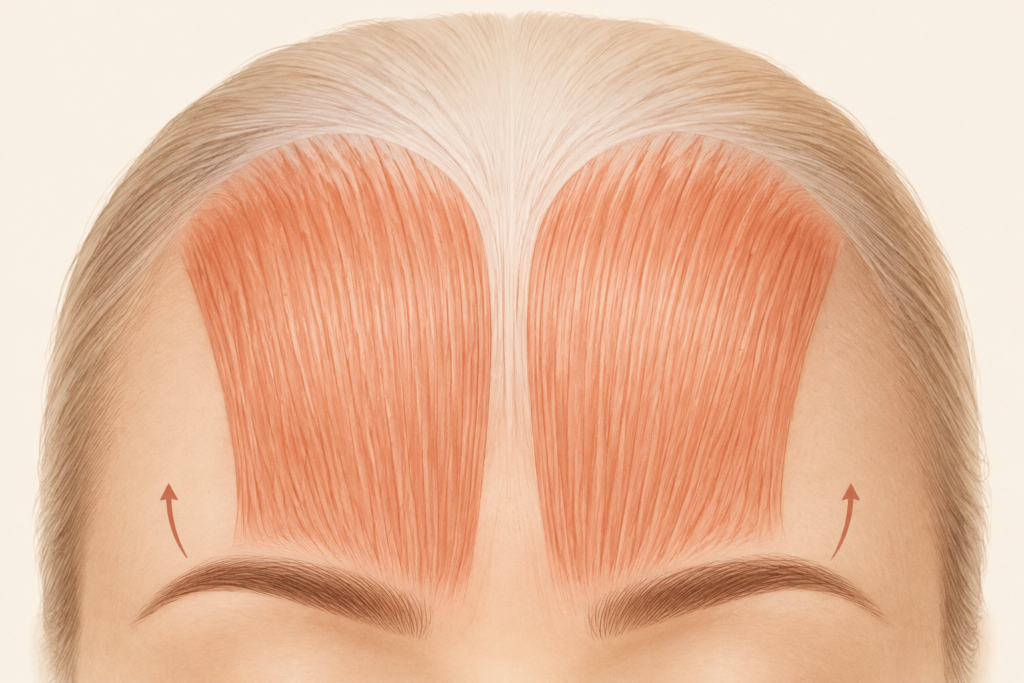
Gentle forehead treatment: why a little can be enough
A thoughtful forehead treatment plan starts with your individual movement. For some people, a small amount may be appropriate to soften lines while preserving the movement that helps support the brows. We take time to explain that balance and agree on a realistic goal with you.
Our aim is to consider both the appearance of your lines and comfortable brow support. A careful assessment helps guide the plan and reduce avoidable heaviness, although it cannot remove the risk completely.
Why does forehead treatment sometimes feel heavy?
The frontalis muscle raises the eyebrows. Some people use it even at rest to help hold up low brows or compensate for upper eyelid heaviness. Reducing too much of this activity can let the brows sit lower. This is different from true eyelid drooping, which can occur when toxin affects the muscle that lifts the upper eyelid.
Does everyone have the same forehead muscles?
No. Muscle shape, strength, distribution and movement patterns vary, as do forehead height, brow position and skin laxity. Some people have strong activity extending low across the forehead. Visible muscle size or deep lines alone do not tell us how much treatment is appropriate; we also need to understand how the forehead supports the brows.
Why can a gentle approach be the right choice?
When someone relies on forehead movement for brow support, a conservative dose, a modified plan or avoiding forehead treatment may be appropriate. Strong muscle activity does not automatically mean a larger dose is better. At London Finsbury Clinic, we explain why preserving some movement may be more important than removing every line.
Can keeping some movement be a good result?
Not necessarily. Some movement or lines may be an intentional compromise to preserve brow position. However, a disappointing result should still be reviewed rather than dismissed. We compare the agreed goal with your response and explain whether further treatment is suitable. Adding more medicine simply to make the forehead completely still may increase heaviness.
Can drooping happen after many treatments without problems?
Yes. Ten previous treatments without drooping do not guarantee that an eleventh will be the same. There is no fixed treatment number at which drooping starts. Brow support, skin and muscle activity can change over time, and the treatment plan and response may also differ. A fresh assessment matters at every visit.
How do you explain the reason for a cautious plan?
Botulinum toxin is a prescription only medicine that may be considered after an individual consultation. The consultation may or may not lead to treatment. It temporarily reduces the nerve signal that makes a muscle contract. In the forehead, that can reduce both skin folding and the upward pull on the eyebrows. We discuss that balance before treatment, including why a lighter result may be preferable and why review does not necessarily mean a top up.
What if my brows or eyelids feel heavy afterwards?
Contact your treating clinician for an assessment, particularly if the change affects your vision. Brow and eyelid drooping need different assessment, and more injections are not a routine fix. Seek urgent medical care for sudden visual loss, severe eye pain or new neurological symptoms, and emergency help for breathing or swallowing difficulty.
How does your doctor’s training experience inform my care?
At London Finsbury Clinic, our doctor has many years of experience training other practitioners in treatment planning and injection techniques. That teaching experience informs a thoughtful approach to your care: understanding your anatomy, explaining the options clearly and choosing a plan suited to you.
You are welcome to ask questions, share any worries and take time to decide. We will explain what treatment may achieve, its limitations and risks, and why a lighter approach, or no treatment, may sometimes be the most appropriate choice.
General patient information, not an individual treatment recommendation. Banner image is an AI generated illustration, not a patient or treatment result.
Consultation, suitability and safety
This article provides general information and does not replace an individual medical consultation. Suitability depends on your medical history, anatomy, skin condition, goals and the treatment being considered.
Risks and recovery: Possible effects vary by procedure and individual. A consultation is required to discuss suitability, alternatives, expected recovery and uncommon complications.
Aftercare: Follow the personalised instructions provided by your clinician. Contact the clinic promptly about severe, worsening or unexpected symptoms, and seek urgent medical help when appropriate.
Sources and further reading
London Finsbury Clinic
104 Judd Street, London WC1H 8BU
07770 741928 · londonfinsburyclinic@gmail.com · WhatsApp