
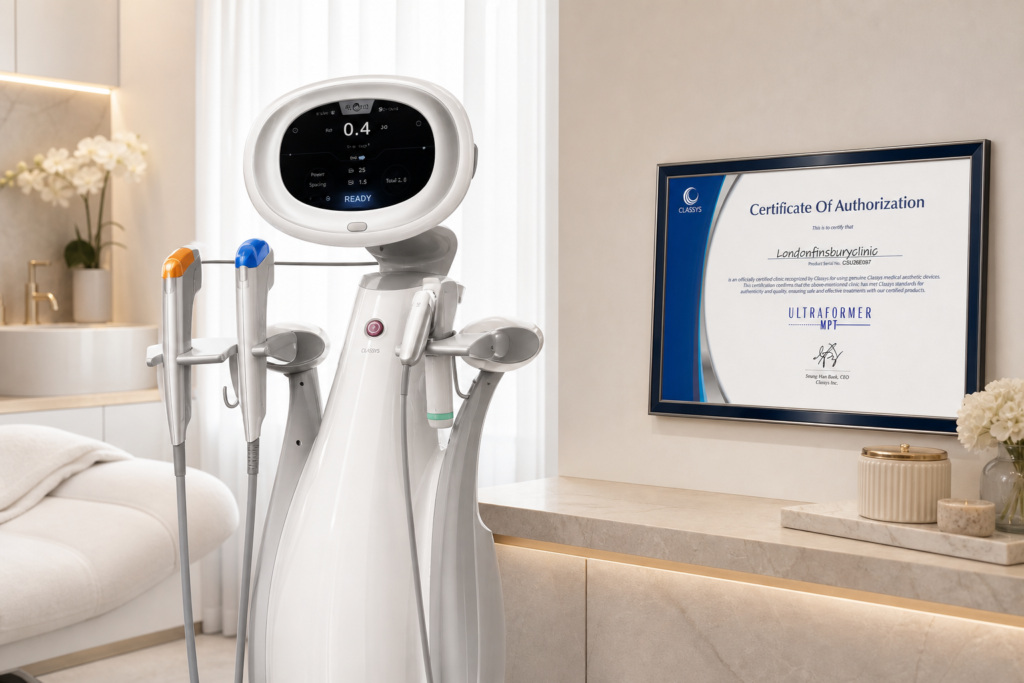
Many clinics advertise “HIFU”, but the name alone does not tell you which device is being used, whether the cartridges are genuine, how many shots are planned or whether the treatment has been designed as a complete clinical protocol. These details matter because the machine, cartridge selection, energy delivery and practitioner technique all influence the quality and consistency of the outcome.
London Finsbury Clinic is officially authorised by Classys
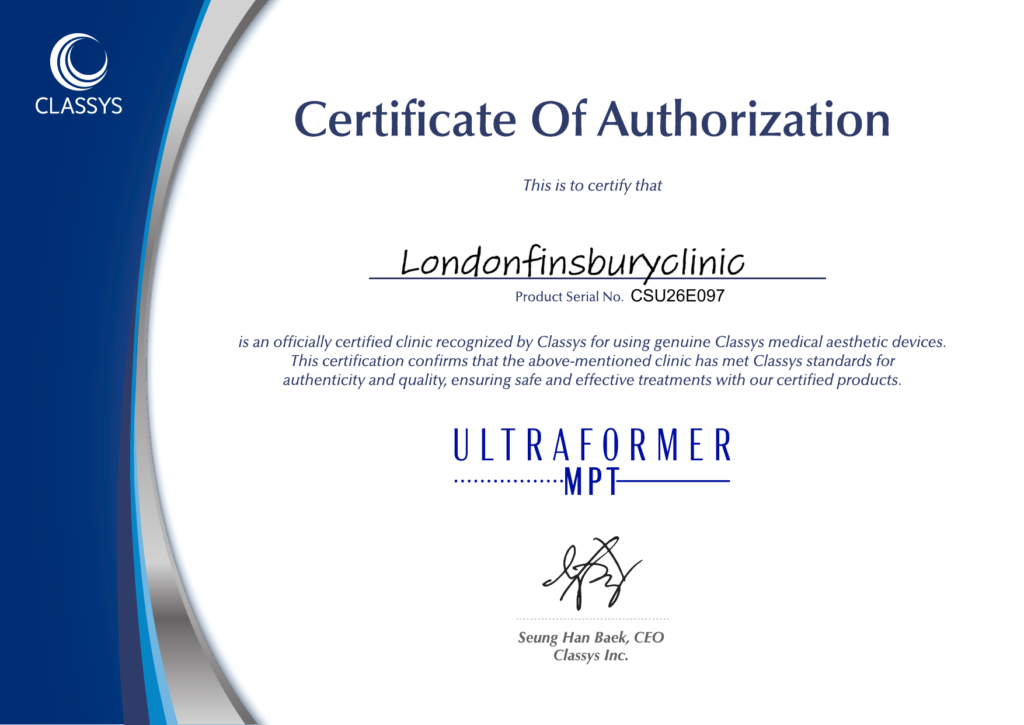
London Finsbury Clinic holds an official Classys Certificate of Authorization confirming that our clinic is recognised for using a genuine Classys Ultraformer MPT medical aesthetic device. The certificate provides patients with clear evidence that the treatment platform is authentic and supplied within the manufacturer’s authorised framework.
Why a genuine Ultraformer MPT device matters
Ultraformer MPT is a specific Classys platform, not a general name for every HIFU machine. A genuine system is designed to deliver focused ultrasound through dedicated cartridges at planned tissue depths. This allows the doctor to build a treatment that can support lifting, tightening, contouring and collagen remodelling while respecting the anatomy of each facial area.
Certification also matters for maintenance, quality control and access to the correct treatment components. Patients should feel comfortable asking a clinic to identify the machine, explain its cartridges and describe the planned treatment before proceeding.
Shots and cartridges should be explained clearly
A high-quality consultation should include a clear discussion of the areas being treated, the approximate number of shots and the cartridge depths selected. London Finsbury Clinic commonly plans around 1,000 shots for a comprehensive face and neck protocol, although the exact number is personalised according to anatomy, treatment area, tissue thickness and clinical goals.
Our doctor may use four or five different cartridges during one treatment. Each cartridge has a different role: some are selected for deeper structural support and facial contouring, while others are used for more superficial tightening, texture and precision work. Using several appropriate depths helps us treat the face as a three-dimensional structure rather than applying the same setting everywhere.
One carefully planned treatment, not repeated short sessions
Our standard Ultraformer MPT protocol is designed as one comprehensive treatment session. When clinically appropriate, maintenance is normally considered at around twelve months rather than dividing a full protocol into frequent small sessions. The objective is to deliver a complete, carefully mapped treatment and then allow time for the body’s collagen-remodelling response to develop.
Individual recommendations can vary with age, anatomy, previous procedures and treatment goals. Your doctor will explain the expected timeline and advise when review or future maintenance is appropriate.
How to check your Ultraformer MPT treatment
- Ask the clinic to confirm that the device is a genuine Classys Ultraformer MPT.
- Request evidence of clinic or device authorisation.
- Ask which cartridges and treatment depths are planned.
- Ask for an estimated shot count for your treatment area.
- Confirm who will perform the procedure and how your anatomy will be assessed.
- Choose a clinic that explains outcomes, aftercare and review clearly.
Our doctor-led Ultraformer MPT approach
At London Finsbury Clinic, treatment is planned around facial anatomy rather than a fixed template. We combine genuine equipment, multiple cartridge depths, detailed mapping and a comprehensive shot protocol to pursue a strong result from one carefully designed session. Outcomes vary with individual tissue response, but our protocol is structured to give the collagen-remodelling process the best possible support.
Frequently asked questions
Is every HIFU machine an Ultraformer MPT?
No. Ultraformer MPT is a specific Classys platform. Clinics should identify the device clearly rather than using “HIFU” as a generic description.
How can I check that the machine is genuine?
Ask to see clinic authorisation, identify the Classys Ultraformer MPT system and request an explanation of the cartridges being used. Our Classys certificate is displayed above.
Why does the number of shots matter?
The shot plan reflects the size and complexity of the treatment. A comprehensive face and neck procedure often requires considerably more coverage than a small-area treatment. We explain the planned count during consultation.
Do you always use exactly 1,000 shots?
We commonly use around 1,000 shots for a comprehensive protocol, but the correct number is personalised to the patient’s anatomy, tissue and treatment areas.
Why are several cartridges used?
Different cartridges target different tissue depths and clinical objectives. Combining appropriate depths allows more complete lifting, contouring, tightening and texture support.
Is one treatment enough?
Our standard protocol is one comprehensive session, followed by progressive collagen remodelling. Maintenance is commonly considered at around twelve months when suitable.
When will I see results?
Some patients notice early tightening, while the result continues to develop as collagen remodelling progresses over the following weeks and months.
Can Ultraformer MPT treat the face and neck together?
Yes. When clinically suitable, the face and neck can be mapped as one connected treatment area using cartridges selected for each anatomical zone.
Does practitioner technique matter?
Yes. Mapping, shot placement, cartridge selection, energy planning and anatomical knowledge are essential parts of a well-designed treatment.
How do I know which protocol is right for me?
A doctor-led consultation assesses laxity, tissue depth, facial proportions, previous treatments and your desired outcome before the protocol is confirmed.
This article provides general information and does not replace an individual medical consultation. Suitability, treatment settings, response and outcomes vary.