
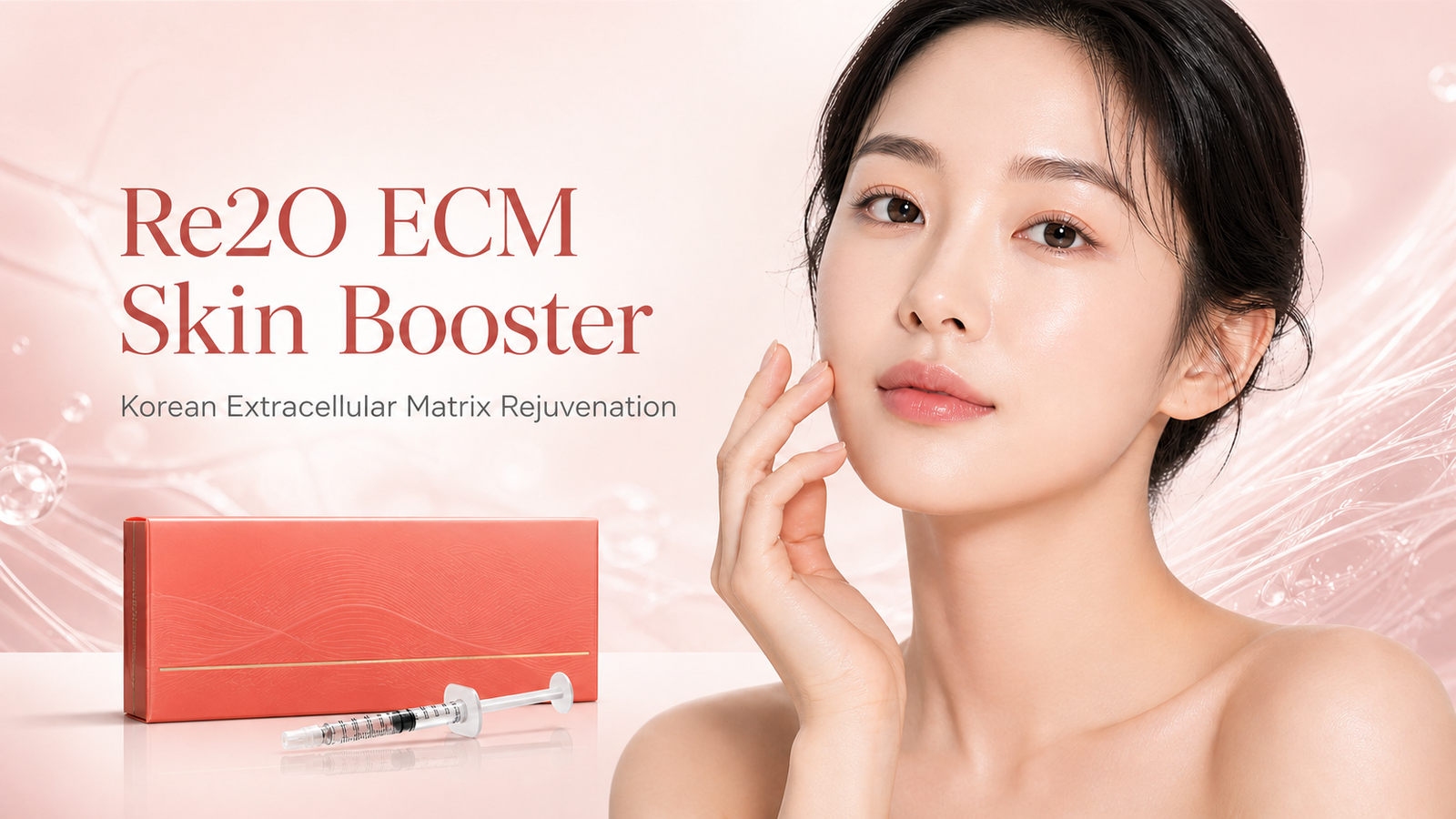
Korean aesthetic medicine is moving beyond treatments that simply add volume. Elravie Re2O introduces a new extracellular matrix approach focused on skin density, texture and structural support.
Korean aesthetic medicine continues to move beyond treatments that simply add volume. One of the most discussed new products is Elravie Re2O, a skin booster developed around extracellular matrix, usually shortened to ECM.
Re2O is unusual because its source material is processed donated human dermis. That description can sound surprising without the right explanation. Re2O is not an injection of human DNA or living human cells. The manufacturer describes it as cell-free allogeneic dermal material that has been processed to remove cells and components associated with an immune response while preserving the tissue’s three-dimensional extracellular matrix.
This article explains what Re2O is, how it differs from familiar Korean skin boosters, and why it is attracting attention for skin quality, density and structural support.
What is Elravie Re2O?
Elravie Re2O is a Korean ECM skin booster distributed by Humedix and developed using tissue-processing technology from L&C Bio. Humedix introduced it as a cell-free allogeneic human dermis product for the aesthetic market.
The extracellular matrix is the supportive network surrounding cells within tissue. It provides an organised structure that helps influence skin strength, elasticity, hydration and repair. Ageing, environmental exposure and inflammation can gradually affect this framework, contributing to thinner skin, reduced firmness, enlarged-looking pores and uneven texture.
Rather than behaving like a conventional hyaluronic acid filler, Re2O is intended to support the environment and structure of the skin itself.
IMPORTANT DISTINCTION
Is Re2O made from human DNA?
No. Describing Re2O as “human DNA” is misleading.
The source is donated human dermal tissue, also called allogeneic dermis. It is processed to become acellular, meaning living donor cells are removed. Humedix states that L&C Bio’s patented AlloClean technology removes cells and factors associated with immune rejection without damaging the tissue’s natural three-dimensional framework.
The important distinction is that Re2O uses the remaining extracellular matrix as a structural skin-quality material. It is not designed to transfer donor DNA or living donor cells.
Anyone considering a human-derived product should receive a clear explanation of its origin, processing, available evidence and alternatives before deciding whether it is right for them.
What is AlloClean technology?
AlloClean is L&C Bio’s patented human-tissue processing method. According to Humedix, the process is designed to remove cellular material and immune-reactive components while retaining the extracellular matrix’s three-dimensional structure.
This matters because the matrix is the part of dermal tissue that provides an organised scaffold. Preserving that framework is what makes Re2O different from injectable treatments based mainly on hyaluronic acid, polynucleotides or collagen-stimulating particles.
What can Re2O help improve?
Humedix describes Re2O as a treatment intended to support fundamental skin regeneration and improvements in pores, skin texture and skin density.
Depending on the person’s skin and treatment plan, the goals may include:
- improving skin density and resilience
- supporting thinner or less elastic skin
- softening the appearance of fine lines
- refining rough or uneven texture
- reducing the appearance of enlarged pores
- creating fresher and firmer-looking skin
- supporting areas where skin quality has declined with age
Re2O should not be presented as a guaranteed transformation. The degree of improvement, the number of sessions and how quickly changes become visible can vary between individuals.
Is Re2O a filler?
Re2O is not intended to work like a conventional facial filler.
A hyaluronic acid filler is generally selected to replace volume, change contour or provide projection in a planned area. Re2O is positioned as an ECM skin booster, with the main emphasis on skin quality, density and structural support.
Some people may notice a healthier or subtly fuller appearance as the condition of the skin improves, but it should not be described as a substitute for a filler when clear structural volume replacement is required.
How is Re2O different from Rejuran and Juvelook?
These treatments can all be discussed under the broad category of Korean regenerative aesthetics, but they are not identical.
Rejuran is based on polynucleotides and is commonly selected to support skin repair, hydration and elasticity. Juvelook combines PDLLA with hyaluronic acid and is used for gradual collagen stimulation and improvements in concerns such as texture, pores and fine lines.
Re2O introduces an extracellular matrix derived from processed human dermis. Its distinctive feature is the preserved acellular dermal framework rather than a polynucleotide or synthetic collagen-stimulating particle.
The best option depends on skin thickness, facial volume, treatment area, previous procedures and the type of improvement the patient wants to achieve. In some cases, a staged combination may be more appropriate than choosing one product alone.
What happens during a Re2O consultation?
A consultation should begin with the skin rather than the product. The clinician assesses skin thickness, texture, elasticity, facial volume, medical history and the areas the patient would like to improve.
The discussion should cover:
- why Re2O is being considered
- the human-derived origin of the material
- how the tissue is processed
- realistic treatment goals
- possible reactions and recovery
- alternative treatments
- the proposed treatment areas and technique
- whether one session or a course may be appropriate
Administration technique and treatment intervals should be chosen by a suitably trained clinician and follow the product information and applicable local requirements.
When might Re2O be considered?
Re2O may be discussed with adults who are concerned about declining skin density, fine lines, enlarged-looking pores, uneven texture or reduced elasticity and who prefer an improvement centred on skin quality rather than obvious facial reshaping.
It will not be appropriate for everyone. Medical history, allergies, skin condition, previous treatments and expectations all need to be reviewed. People who are uncomfortable with a human-derived material should be offered a clear discussion of non-human-derived alternatives.
What should patients know before choosing Re2O?
Re2O is a relatively new development in Korean aesthetic medicine. Interest is growing, but marketing language should not run ahead of the available clinical evidence.
Patients should ask who manufactures and distributes the product, whether it is supplied through an appropriate channel, what training the practitioner has completed, and what evidence supports the proposed use. They should also receive the product name and a record of what was administered.
The most responsible approach is transparent and individual. Re2O should be recommended because it matches the person’s skin and goals, not simply because it is a trending Korean treatment.
COMMON QUESTIONS
Frequently asked questions
Is Elravie Re2O the same as RE20?
The official product name is styled Elravie Re2O. The final character is the letter O, although the name is frequently typed online as RE20.
Does Re2O contain living human cells?
Humedix describes Re2O as cell-free allogeneic dermis. Its AlloClean processing is intended to remove cells and immune-reactive components while preserving the extracellular matrix structure.
Is Re2O an injection of human DNA?
No. It is more accurately described as an acellular extracellular matrix material derived from processed donated human dermis.
Does Re2O add facial volume?
Its primary purpose is skin quality, density and structural support rather than the projection associated with a conventional filler. Any treatment plan should distinguish clearly between improving skin condition and replacing lost facial volume.
How many Re2O sessions are needed?
There is no single course that suits everyone. Session number and interval depend on skin condition, treatment goals, clinical assessment and the manufacturer’s guidance.
How quickly will results appear?
Changes in skin quality are generally assessed progressively rather than immediately. Timing and degree of improvement vary, and results should not be guaranteed.
Can Re2O be combined with other treatments?
A clinician may consider a staged plan involving other skin boosters, collagen stimulators or energy-based treatments. Timing matters, so combinations should be planned after assessing the skin rather than added automatically.
A new category in Korean skin rejuvenation
Elravie Re2O represents a different direction in Korean regenerative aesthetics. Its key feature is not simply another active ingredient. It is the use of a processed, cell-free human dermal extracellular matrix intended to support skin density, texture and resilience.
The human-derived origin deserves a clear and factual explanation. Re2O is not “harvested DNA,” and it does not contain living donor cells according to the manufacturer. It is an acellular dermal matrix produced with technology designed to remove cellular and immune-reactive material while preserving the supportive tissue framework.
For the right patient, this may offer an interesting new approach to skin rejuvenation. The decision should always follow an individual consultation, a transparent discussion of the material and realistic expectations about what a skin booster can achieve.