+44 7770 741928104 Judd Street, London, WC1H 8BU · WeChat ID: Finsburycliniclondonfinsburyclinic@gmail.com
London Finsbury Clinic

Certified Juvelook clinic · International Juvelook trainer

Juvelook for hair loss in London.
Scalp assessment. A personal plan.

Explore doctor-led Juvelook scalp treatment at London Finsbury Clinic, a certified Juvelook clinic in King’s Cross with international-trainer experience. We start with the cause of thinning and explain whether a scalp-supporting approach is appropriate for you.

The manufacturer includes hair restoration in its cellular research explanation. We discuss the emerging evidence clearly, alongside established options, with genuine product, an agreed treatment amount and personal aftercare.

Certified clinic · View trainer documentation →

From £749 · scalp treatment

500+reviews across three independent platforms
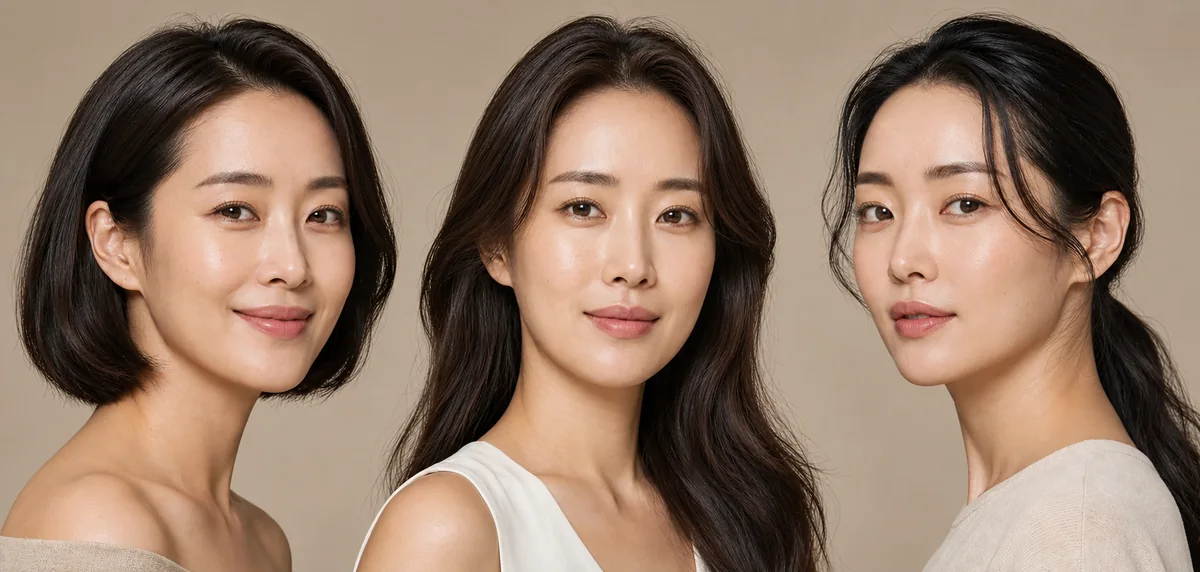
Editorial portrait representing natural facial features; not a treatment result

Your scalp. Your hair. A thoughtful plan.

A focused plan for your hair.
Care for your scalp.

Hair thinning is a symptom with more than one possible cause. We assess the pattern, scalp health, timing and medical background before discussing a cosmetic scalp treatment.

The aim is an informed plan for your scalp and hair concerns. Juvelook is an emerging supporting approach; it is not a guaranteed regrowth treatment or a replacement for established care.

How does Juvelook work? →

Experience, with a personal approach.

Our certified clinic combines international Juvelook trainer experience, repeated visits to South Korea and careful doctor-led assessment. We explain the product, amount and technique selected for you, with time to ask questions.

Suitable preparation, numbing, attentive treatment, aftercare and skincare advice are included. Your doctor reviews the response before recommending more.

Quick overview

Treatment priceFrom £749
ConsultationFree and doctor-led
NumbingIncluded where suitable
DowntimeTemporary swelling or bruising possible
ResultsResponse and review discussed personally
Treatment planPersonal review before further care
FocusHair thinning, scalp condition and emerging PDLLA research
AftercareIncluded, with skincare advice

Clear treatment choices · complete prices

Your Juvelook scalp treatment.

More included in your personalised scalp plan

Our clinic combines scalp-focused Juvelook treatment with selected NCTF 135 HA at no additional cost where appropriate. When clinically indicated, a complementary relaxer treatment may also be included for scalp oiliness, excessive sweating or an individually assessed muscle-related concern. Your doctor explains each component and its purpose before treatment.

Scalp comfort and oil or sweat control are assessed separately from hair growth. The products, administration and timing are planned individually.

Your hair and scalp appointment

Juvelook scalp assessment & treatment

One agreed treatment appointment

A personalised approach to thinning hair and scalp condition. Juvelook provides a PDLLA-based biostimulatory component, with selected NCTF 135 HA and clinically indicated scalp relaxer care included in the agreed plan. We consider scalp tissue, oiliness and sweating alongside your pattern of hair loss. Your doctor agrees the coverage and prepared amount, with suitable numbing, administration, scalp-care advice and aftercare included.

See scalp before-and-after examples →

Explore the hair and scalp mechanism →

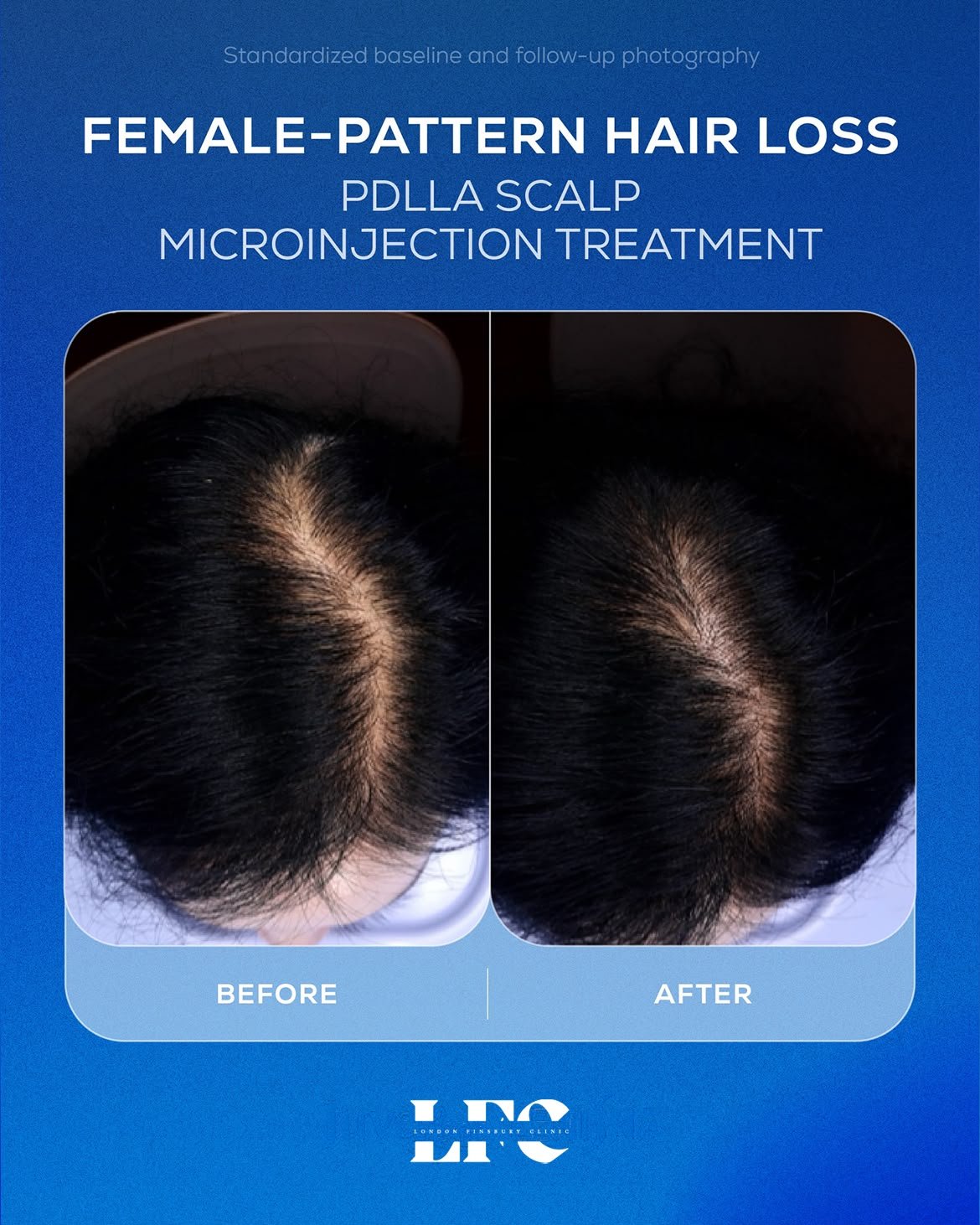
Hair and scalp comparisons

Juvelook scalp before and after.

Explore these PDLLA scalp comparison examples from our existing treatment-image library. They illustrate changes in scalp coverage and the appearance of thinning; individual outcomes vary. Published-study examples are not presented as verified London Finsbury Clinic patient cases.

Images alone do not establish hair counts or prove which component caused a change. Read the published scalp pilot study and its original photographic examples ↗

Inside your treatment

What is Juvelook for the scalp?
PDLLA and hyaluronic acid.

Standard blue-cap Juvelook vial
Standard Juvelook · product photograph

A Korean injectable combining biodegradable PDLLA microparticles with a non-crosslinked hyaluronic acid carrier. For scalp care, the interest lies in the tissue environment around hair follicles and the emerging research on follicle-related signals.

Original vial
50mg before preparation
PDLLA
42.5mg poly-D,L-lactic acid
HA
7.5mg non-crosslinked hyaluronic acid
This page
Scalp support and emerging hair-restoration research

Prepared syringe volume depends on preparation. Your doctor explains the agreed amount and concentration. Lenisna / Juvelook Volume is a separate formulation for a different treatment purpose.

The scalp environment · follicle signals · gradual review

How Juvelook is being studied for hair.

The aim is to support the tissue surrounding existing follicles. The research explores biological signals and scalp structure, rather than treating hair loss as a single cosmetic problem.

01

PDLLA in supporting tissue

Porous PDLLA microparticles interact with cells in the surrounding tissue; the HA component acts as a carrier.

02

Cell-to-cell signalling

Laboratory work explores Piezo1 signalling and a shift towards M2 macrophages, with signals such as HGF and IGF-1.

03

Follicle activity

Researchers study how those signals relate to follicle stem-cell activity, the hair-growth phase and the tissue around follicles.

04

Measure your response

Photographs and follow-up help assess visible change in a person. Laboratory pathways do not guarantee new hair growth.

The follicle-signalling work includes cell and mouse experiments. Read the primary PDLLA hair-follicle study ↗

Follicles, thickness and hair quality

Dermal papilla cells help regulate hair formation. A separate Korean study explored oxidative stress, IGF-1 signalling and keratin-related activity in laboratory models, with animal work on age-related changes in hair. This provides a research rationale for studying hair quality; it does not establish the same outcome in every patient.

Explore the hair-thickness and follicular-ageing research ↗

Scalp tissue and its blood supply

The environment around a follicle includes supporting tissue, immune cells and small blood vessels. PDLLA research investigates tissue remodelling and vascular signalling. Your doctor relates this developing science to your diagnosis, rather than assuming collagen stimulation corrects every cause of hair loss.

Human scalp evidence

A Korean-led pilot series followed 20 adults receiving Juvelook scalp microinjections; some also had light microneedling. Photographic assessments suggested improvement over 12–24 weeks, but there was no comparison group or objective hair-count measurement. It is early clinical evidence, not proof of superiority over established treatments.

Read the human scalp pilot study ↗

Korean hair-restoration research

Dr Jino Kim and the scalp research context.

Clinical work in Seoul

Dr Jino Kim is a Director at NEWHAiR Seoul. His official profile lists hair transplantation, hair-loss evaluation and treatment, and an outpatient professorship at Yonsei University College of Medicine. He is a co-author of the published Juvelook scalp pilot series and PDLLA hair-quality research.

VAIM’s report of JUPITER Symposium 2026 identifies Dr Kim among the speakers discussing hair quality, shine and scalp-cell research. These references explain the Korean research background; they do not imply that he treats patients at or endorses London Finsbury Clinic.

Dr Jino Kim’s official profile ↗ · VAIM’s JUPITER 2026 report ↗

Supporting tissue around follicles

A hair follicle sits within a living network of connective tissue, blood vessels and signalling cells. Scalp tissue and its fatty layer can change with age and some hair-loss patterns, but thinning hair does not mean everyone has the same tissue change. Your doctor assesses the scalp rather than assuming one cause.

The extracellular matrix, or ECM, is the framework surrounding cells. Collagen and elastin form part of that framework. PDLLA research explores remodelling of supporting tissue and follicle-related signals; this is a different concept from transplanting hair or directly blocking every hormonal driver of loss.

Growth-factor names, explained

The scalp studies discuss several signalling pathways. HGF and IGF-1 appear in the follicle stem-cell research, while VEGF refers to vascular endothelial growth factor in blood-vessel research. VEGF is distinct from “VGF”; the names should not be used interchangeably. A proposed pathway is not itself proof that a combined clinic treatment produces more human hair.

Particle design and careful placement

Juvelook uses porous, rounded PDLLA microparticles with a hyaluronic acid carrier. Material structure, preparation, distribution and injection technique matter. A scalp treatment still requires an assessment and appropriate follow-up: the particle design does not make nodules impossible or establish a universal scalp complication rate.

Part of a wider hair-loss plan

Scalp-supporting procedures may be considered alongside established medication or hair-restoration procedures for suitable male- and female-pattern thinning. The diagnosis, existing treatment and your goals guide the sequence. Your doctor explains where Juvelook may add a supporting role and when a different treatment is more appropriate.

Your clinic protocol, explained

Why we consider more than one scalp concern.

Juvelook and selected NCTF 135 HA

Our clinic uses Juvelook as the biostimulatory part of a personalised scalp plan. Selected NCTF 135 HA can be included at no additional cost where appropriate. We explain its hydration-focused role separately from the PDLLA component. Their use together is our clinic protocol; it is not the same as a clinical trial proving that this exact combination regrows hair.

Scalp oiliness and sweating

When clinically indicated, relaxer treatment may be considered for excess scalp oil or sweating. These are different treatment targets from follicular growth. A randomised scalp-sebum study investigated oil control, while a clinical head-and-forehead study reported reduced sweating. Your symptoms and assessment determine whether either goal is relevant.

Scalp-sebum trial ↗ · Head and scalp sweating study ↗

Muscle relaxation and hair growth

Reducing activity in selected scalp-associated muscles is one proposed rationale studied in hair-loss research. Injection into muscle and injection into scalp skin have different purposes. Hair-growth trials have produced mixed findings: a 2024 combination trial reported benefit alongside minoxidil, while a 2025 trial did not show increased density. Muscle relaxation, reduced oiliness or reduced sweating should not be described as guaranteed hair regrowth.

Combination hair-loss trial ↗ · Scalp and muscle-injection trial ↗

Our experience and your review

Our clinic experience informs this combined approach: we look at thinning hair, scalp tissue and symptoms together, aiming for a worthwhile, carefully planned appointment. Your own starting photographs, response and follow-up guide whether more care is useful. We do not require you to commit to a package before reviewing progress.

Before. During. After.

Your appointment, with care.

Listen and plan

Bring details of earlier fillers, devices, surgery, medicines and allergies. We assess your skin and explain suitability, the proposed technique and complete price.

Prepare and treat

We allow suitable numbing time, prepare the skin and check your comfort throughout. You can ask for a pause or further explanation.

Settle and review

You receive personal advice for skincare, activity and contacting the clinic. We plan review around the treatment and your response.

Temporary redness, swelling, tenderness or bruising can occur. Delayed lumps, infection and rare serious injection complications are discussed during consultation, together with area-specific precautions and when to seek help.

Doctor-led treatment in King’s Cross

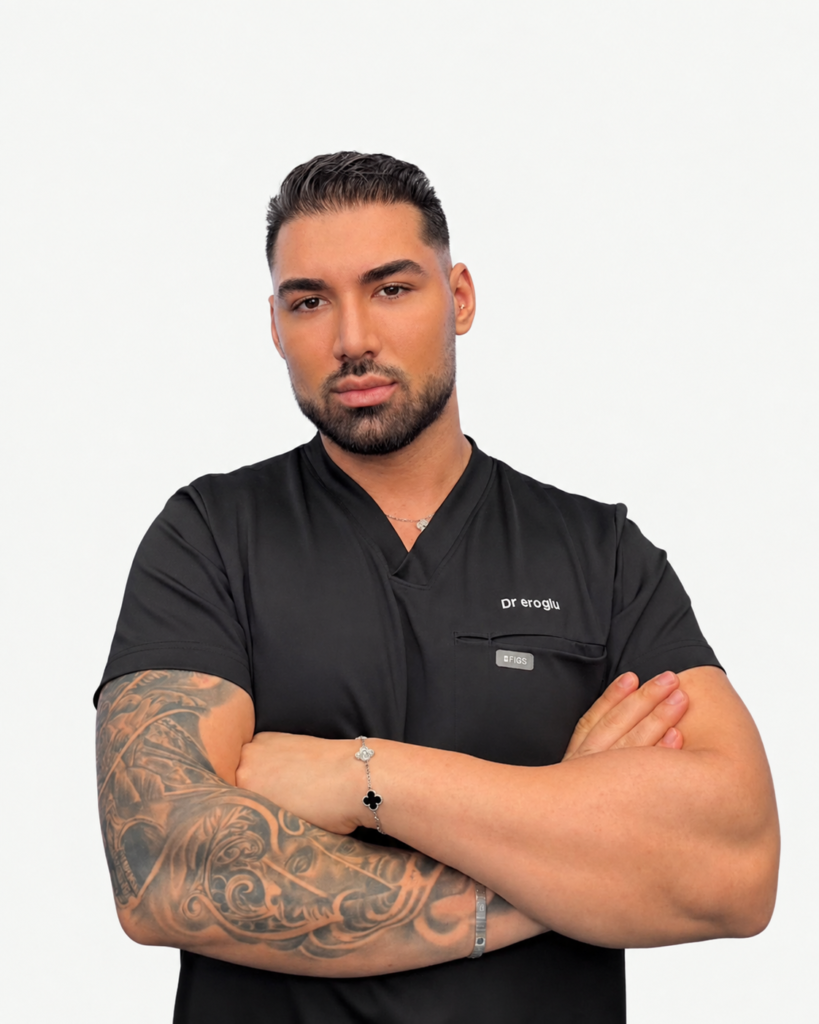
Meet Dr. Eroglu

Dr. Eroglu

Founder of London Finsbury Clinic and an international Juvelook and Lenisna (Juvelook Volume) trainer, Dr. Eroglu combines Korean collagen-stimulation protocols with a personal, doctor-led approach.

Your consultation starts by listening to your hair and scalp concerns. We assess the pattern of thinning, shedding, scalp condition, oiliness, sweating and previous hair-loss treatment before recommending a plan. Dr. Eroglu also has four years of advanced CPD teaching experience, training other practitioners in anatomy, techniques and treatment planning. Your doctor explains the ingredients, amount, suitability and proposed course before you decide.

We welcome local and international patients, with treatment and review planned around your needs. Our aim is a refreshed appearance that respects your natural features.

Read more about Dr. Eroglu →

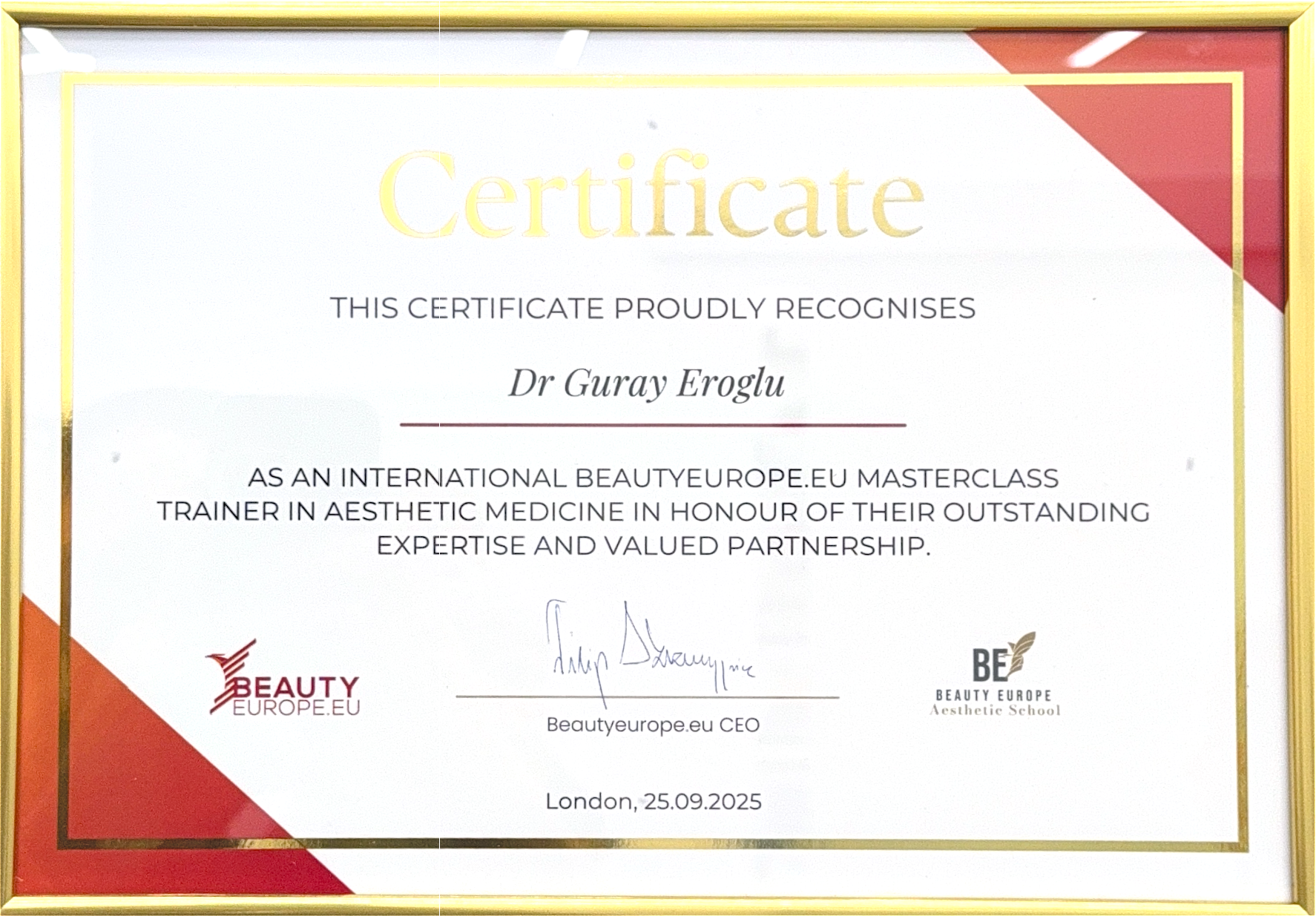
The displayed certificate was issued when Beauty Europe / B2 Europe was the UK distribution and training partner. It documents the training completed during that period; distribution arrangements have since changed.

Dr Guray Eroglu international trainer certificate

PDLLA + HA · from particles to skin quality

The manufacturer’s cellular explanation.

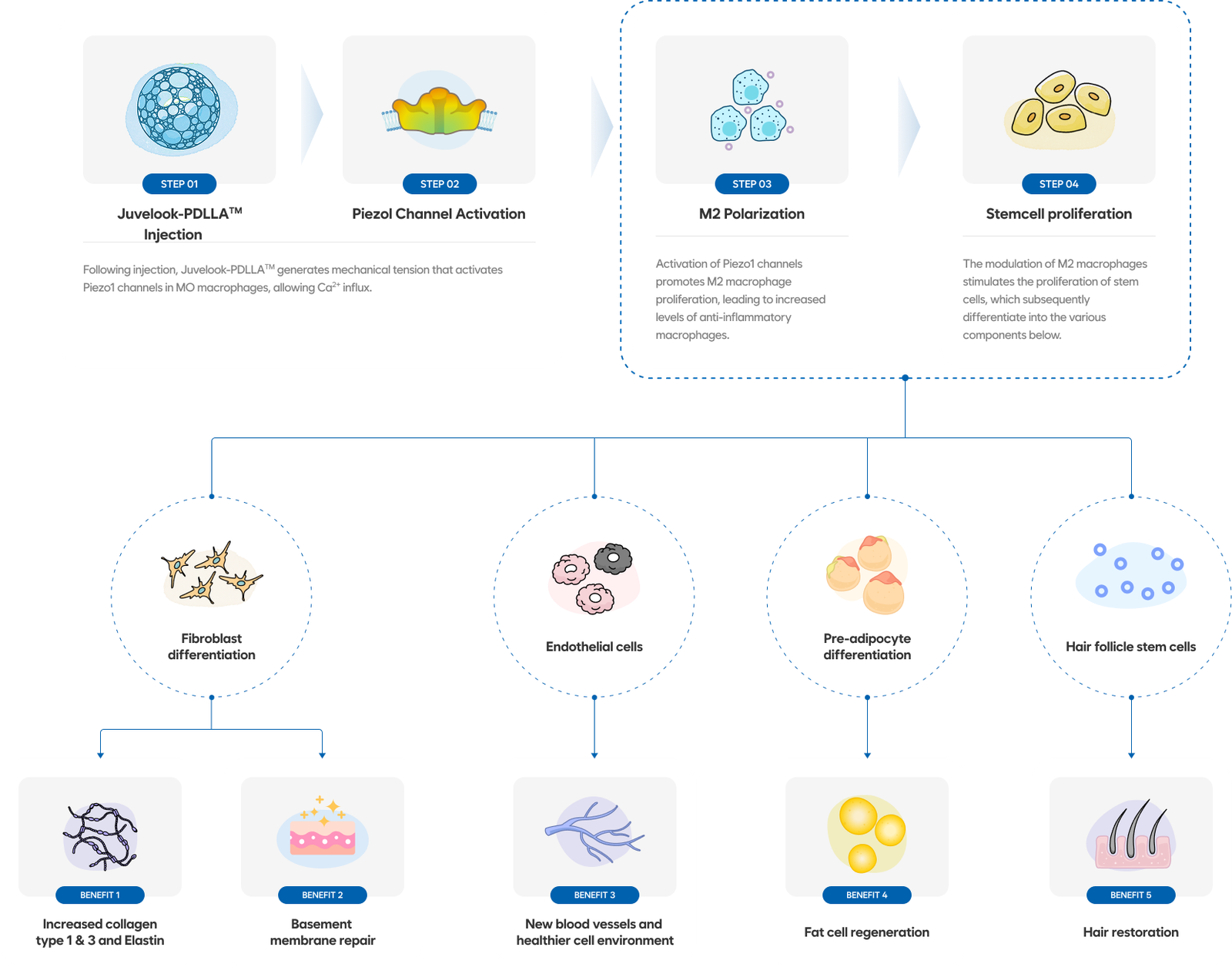
VAIM describes a sequence involving mechanical signalling through Piezo1 channels, calcium entry, a shift towards M2-type macrophage activity and signals to neighbouring cells. Its diagram connects these pathways with fibroblasts, vascular cells, fat-cell precursors and hair-follicle stem cells.

VAIM manufacturer diagram of PDLLA particle interactions, Piezo1, macrophages and downstream cell pathways
Open the full-size mechanism diagram ↗
Manufacturer educational diagram © VAIM / Juvelook. These pathways include laboratory and animal research; the diagram does not establish every listed effect in patients or every treatment area.

Read the official manufacturer mechanism and benefits explanation ↗

Inside the formulation

Why the particle design matters.

Porous, spherical PDLLA

The manufacturer describes a porous internal network created through its particle-manufacturing process. It is designed to support cell interaction and degradation through hydrolysis. PDLLA and PLLA share a lactic-acid polymer family but have different material structures and behaviour.

Biodegradable describes the material breaking down over time; it is not a promise that the tissue response disappears on an exact date.

Hydrating HA carrier

Standard Juvelook contains 42.5mg PDLLA and 7.5mg non-crosslinked HA in an original 50mg vial. Prepared millilitres depend on reconstitution. Your doctor explains the amount and preparation selected for the agreed area.

Lenisna / Juvelook Volume is a separate formulation. Its larger original content and different particle profile are used for a different treatment purpose.

Manufacturer particle technology ↗ · Compare Lenisna / Juvelook Volume →

Material properties and scalp decisions

Does scalp Juvelook require heat?

Hydrated PDLLA has temperature-dependent physical properties, but that is different from demonstrating extra hair growth after heating the scalp. Our scalp appointment is not automatically a facial MPT or peel protocol. Any device proposal needs its own scalp-specific purpose, evidence, suitability assessment and agreed fee.

Read the product mechanism and material-property guide →

Hair research in context

What the scalp science tells us.

There are now laboratory, animal and early human PDLLA scalp studies. Their methods and outcomes differ. The important distinction is between a plausible follicle-supporting mechanism, an improvement in photographs and a measured increase in human hair density.

Our consultation considers the cause of loss and where established care remains important. We explain the role of each proposed component and assess your individual response; there is no evidence here that our exact combined protocol is stronger than every alternative.

Explore the scalp-specific research above →

Included care · clear agreement

What your treatment fee includes.

Your listed appointment includes doctor assessment, suitable numbing, agreed treatment administration, personal aftercare and skincare advice. The product, prepared amount, treatment area and any included combination are explained before treatment.

Additional areas, products or procedures are separately agreed and priced. You can review your response before deciding on further paid care; there is no compulsory package.

Hair and scalp questions

Juvelook scalp treatment FAQs

What is included in the £749 scalp appointment?

Doctor assessment, the agreed Juvelook scalp treatment, suitable numbing, aftercare and scalp-care advice are included. Selected NCTF 135 HA and clinically indicated relaxer care may be included in your individual plan at no additional cost. Coverage and administration are confirmed first.

What is in Juvelook?

The standard vial contains 42.5mg PDLLA and 7.5mg non-crosslinked hyaluronic acid before preparation. Prepared liquid volume is different from the original product amount. Your doctor explains the agreed preparation.

How does Juvelook relate to hair follicles?

Research explores PDLLA interactions with supporting tissue, macrophage signalling and follicle-related cells. Cell and animal findings provide a rationale for research; they do not guarantee the same result in a person.

Is there human research on scalp Juvelook?

Yes. A small Korean-led pilot series reported photographic improvement after scalp microinjections, sometimes with microneedling. The lack of a comparison group and objective hair counts limits what can be concluded.

Can I see scalp before-and-after examples?

Yes. The scalp comparison section is directly after pricing, with full-size images available. Published-study examples are not presented as verified London Finsbury Clinic patient cases. Individual results vary.

Why might NCTF 135 HA be included?

Our clinic may include it as a hydration-focused component of an individually assessed scalp plan. Its purpose, preparation, timing and administration are explained separately from Juvelook. It is not presented as a proven independent hair-regrowth treatment.

Why might relaxer be considered for my scalp?

When clinically indicated, your doctor may consider it for excess scalp oil, excessive sweating or selected muscle-related concerns. These are separate goals from hair growth, and the intended purpose is explained before treatment.

Does reducing scalp sweating or oil guarantee hair growth?

No. Better scalp comfort and symptom control do not automatically mean increased follicle density. We assess and review each goal separately.

What does muscle relaxation have to do with hair loss?

Researchers have investigated scalp-associated muscle tension as one possible factor. Hair-growth trials are mixed, and injections into muscle differ from superficial scalp injections. Suitability and technique require individual medical assessment.

Which hair-loss patterns can you assess?

We assess male- and female-pattern thinning, a widening parting, hairline changes and increased shedding. The history and scalp examination guide whether Juvelook, established treatment, investigations or specialist care are appropriate.

What if my scalp is sore, inflamed or has patchy loss?

These symptoms need assessment before a cosmetic scalp procedure. Suspected scarring, infection or an active inflammatory condition may need different treatment or referral.

How long should I allow to assess a response?

Hair changes develop gradually over months. We agree a follow-up plan, consistent photographs and meaningful goals for your starting condition. Timing is personalised rather than copied from a facial treatment schedule.

Will I need a package of sessions?

There is no compulsory package. The starting treatment and review are agreed first; further visits depend on your response and the proposed plan.

Should I stop my current hair-loss treatment?

Do not change an existing treatment solely because you are considering scalp Juvelook. Tell your doctor what you use so any proposed combination fits your diagnosis and current care.

Is the clinic claiming this is better than every other hair-loss treatment?

No. Our clinic experience informs an individual approach, but a universal comparison would require controlled evidence for the same protocol. The aim is a worthwhile plan matched to your scalp and hair concerns.

Where is the clinic?

London Finsbury Clinic is at 104 Judd Street, King’s Cross, London WC1H 8BU.

Start with a conversation

Your skin.
A plan that feels personal.

Meet your doctor to understand your skin concerns and compare suitable Juvelook options and combinations, without pressure to choose treatment.

104 Judd Street, King’s Cross, London WC1H 8BU. A short walk from King’s Cross and St Pancras International.

Contact & directions → · Aftercare guidance → · 中文诊所介绍 →

Manufacturer information · primary research

Explore the scalp sources.

Juvelook product technology and hair studies

Official Juvelook PDLLA particle technology ↗ · Official cellular mechanism and hair-restoration pathway ↗

Human PDLLA scalp pilot series ↗ · Hair-follicle stem-cell study ↗ · Hair thickness and follicular ageing ↗

Human outcomes, laboratory mechanisms and clinic experience answer different questions. The detailed sections above explain each source in context.

Related product guides

Understand your Juvelook options.

The mechanism guide

Read about PDLLA, the HA carrier, particle design and the distinction between a proposed biological pathway and a clinical result.

Explore how Juvelook works →

Compare all treatment areas

Our main Juvelook page connects area-specific information with complete prices and the relevant booking options.

View the main Juvelook page →

Enlarged treatment example