
The science of PDO collagen stimulation
How ULTRACOL works
See how biodegradable PDO microspheres prompt a local tissue response and why ULTRACOL 100 and 200 are chosen for different concerns.
Explore the mechanism ↓View treatment and prices →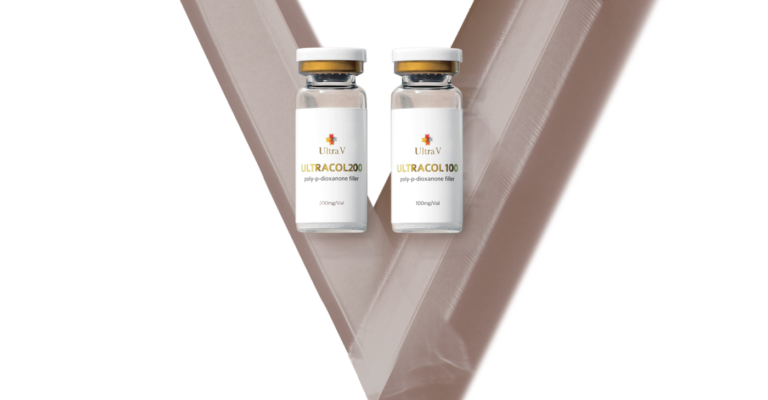
What is ULTRACOL?
Small spheres, a gradual collagen response
ULTRACOL contains polydioxanone (PDO), a biodegradable material also used in absorbable sutures. Here it takes the form of microspheres. Their contact with local tissue is associated with new collagen formation in experimental research.
The manufacturer’s mechanism, step by step
From microspheres to collagen
 1
PDO microspheres
Tiny biodegradable polydioxanone particles are present in the treated tissue.
 2
Local tissue response
Immune cells, including macrophages, respond to the particles.
 3
New collagen
Fibroblasts make new collagen fibres, including type I, as part of tissue remodelling.
 4
PDO biodegrades
Water in the tissue gradually breaks down the PDO.
 5
Collagen remains
New collagen can remain as the material breaks down. The visible change and timing vary.
Educational sequence adapted from Ultra V’s mechanism material.
Which formulation fits the concern?
ULTRACOL 100 · Skin quality
Considered for fine lines, texture, visible pores and reduced elasticity. A full-face skin-booster plan can include suitable under-eye skin.
ULTRACOL 200 · Facial support
Considered where volume loss or reduced support contributes to hollowing or folds. Your doctor assesses the cheeks, temples, smile lines and marionette lines and confirms which areas are suitable.
What has been studied?
Collagen stimulation · Skin texture · Radiance and brightness · Visible pores · Facial volume and support.
A small ULTRACOL 100 study in the smile-line area assessed texture, radiance and pore size. In one subgroup, measured pore size fell by 12.14% four weeks after the first treatment. Individual results vary by area and treatment plan.
Ultra V describes the total microsphere surface area in a vial of ULTRACOL 200 as comparable to approximately 1,427 specified PDO mono threads. This describes material surface area. Clinical outcomes such as lift, collagen production and recovery require separate evidence.
Material, tissue response and clinical assessment
How the form of PDO changes its role
Microspheres and local tissue
Ultra V’s diagram shows macrophages and other immune cells gathering around the spherical PDO particles. Fibroblasts form new collagen fibres as the tissue remodels. Over time, hydrolysis breaks down the PDO while some of the new collagen can remain in the tissue.
PDO threads and HA gels
A PDO thread is a long strand that can provide mechanical support. Hyaluronic acid gel can add physical support or volume at the time of treatment. ULTRACOL uses dispersed PDO microspheres to support a gradual collagen response. The surface-area comparison above describes the material, while the clinical effects depend on how each product is used.
Choosing which areas to assess
Ultra V discusses the forehead, temples, cheeks and under-eye skin, as well as selected neck, décolletage, hand and depressed scar concerns. Your clinician considers whether the priority is texture, elasticity or facial support, along with skin thickness, anatomy and previous treatments.
What Ultra V reports
- +70% increase in skin volume at eight weeks
- +56% improvement in skin texture
- +16% skin brightening
- −20% reduction in pores
Source: ULTRACOL manufacturer flyer. These are manufacturer-reported figures. Individual results vary.
Treatment timing and options
The flyer describes changes developing over about four to twelve weeks and outlines two visits four to eight weeks apart where clinically appropriate. Your clinician assesses whether a second visit or later maintenance would be useful.
ULTRACOL 100 and ULTRACOL 200 are each £1,199 total for one session, including one single-use vial. Choose a treatment or free consultation.
Questions about ULTRACOL
Why does the response take time?
Collagen formation and tissue remodelling develop gradually. Your clinician can help you understand the likely timeline for the area being assessed.
Is this the same procedure as a PDO thread lift?
The products use PDO in different forms. ULTRACOL uses microspheres, whereas a thread lift uses longer threads to provide mechanical support.
Can I choose the formulation myself?
Your doctor checks whether skin quality, loss of volume or another concern is driving what you see and discusses the options with you.